What if I don’t want an upgraded meter?

Customers who want to keep their existing meters can call NorthWestern at 888-467-2669 or email NorthWesternEnergyMeters@northwestern.com to be added to the bypass list. Customers who previously requested an opt out do not need to contact NorthWestern again to be bypassed and keep their meters.

NorthWestern will be reaching out to customers who received an advanced meter despite their request to opt out. For those who still wish to opt-out, NorthWestern will ensure that the advanced meter is removed and replaced with a meter similar to the one that was there before. Customers will not be charged for this service. 

Customers who have questions about the advanced meter opt-out program can contact NorthWestern at 888-467-2669
or the Montana Public Service Commission at 1-800-646-6150 or pschelp@mt.gov.


NorthWestern Energy Meter Project

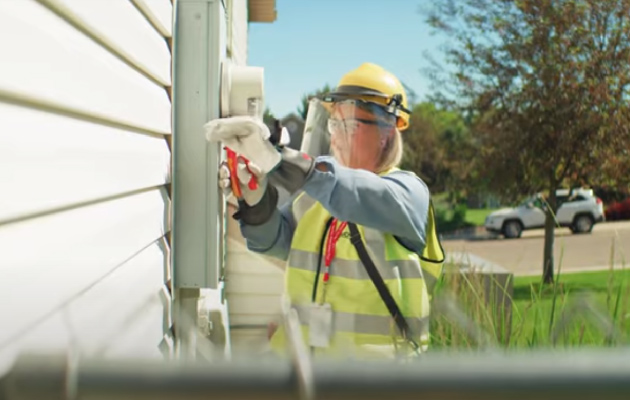
A contractor with NorthWestern Energy changes out a meter.

NorthWestern Energy Meter Project

Watch a video to learn about the benefits of our new meters and what to expect when your meter is changed out.

How do I read my meter?

Click the links below for instructions on how to read your meter, self-read dates and a postcard you can use to submit your meter readings.

Gas meter

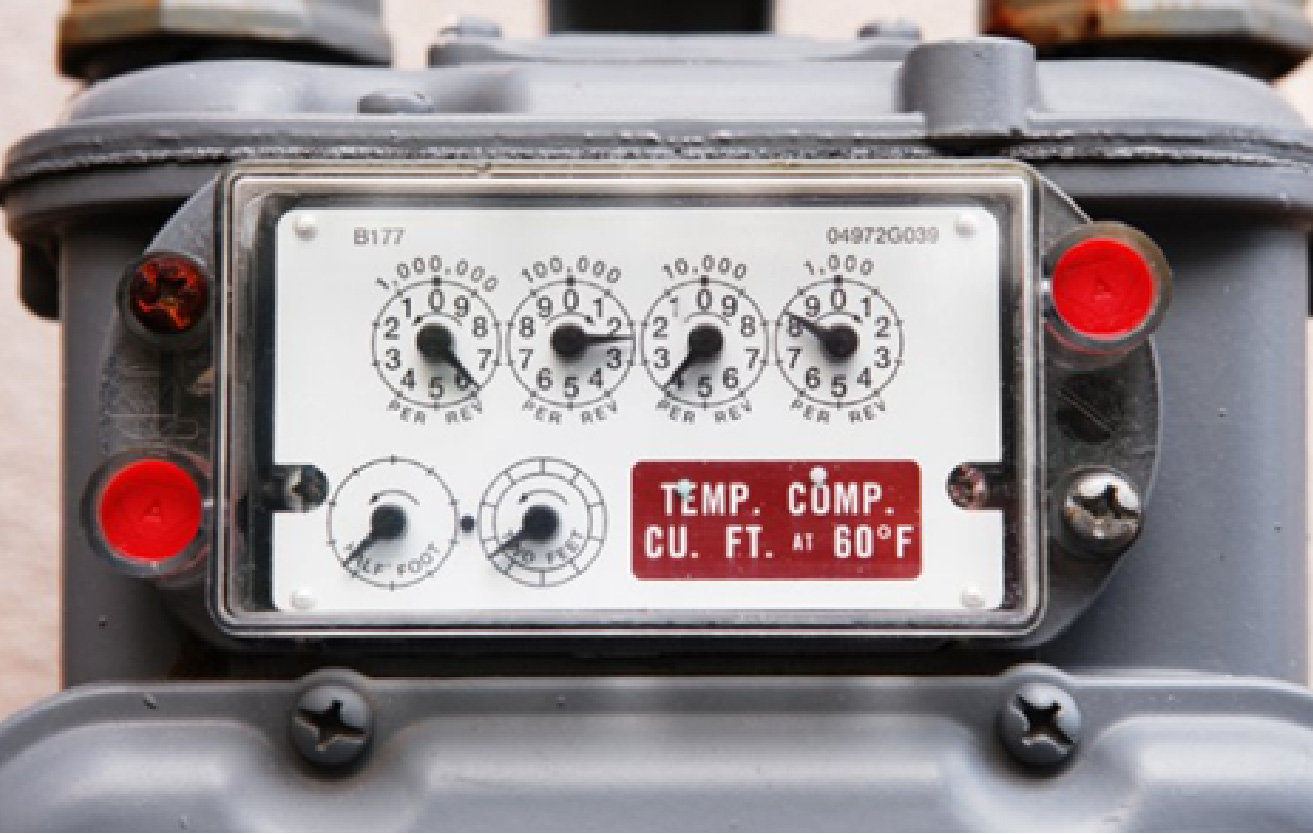
an up-close view of the dials on a gas meter

Gas meter

Natural gas dials represent the amount of natural gas measured in volumes of hundreds of cubic feet (ccf). 

A gas meter is driven by the force of the moving gas in the pipe, and also turns faster as the flow increases. Each time the dial with the lower value makes one complete revolution, the pointer on the next higher value dial moves ahead one digit.

To read your meter: 

  • Be at eye level of the dials.
  • Mark the dials from left to right.
  • Take note of the direction of the arrows on the display – the pointer of adjacent dials turn in opposite directions to each other.
  • Draw the pointer on the dials as displayed on your gas meter.
  • When the pointer on the dial is between two numbers, record the lower number.
    • If the pointer is between 9 and 0, 9 is the lower number.
  • When the pointer is directly on the number, look at the dial to its right:
    • Has the dial on the right has passed 0, yes, use the number that the pointer is on.
    • The dial on the right has not passed "0," use the number less than what the pointer is on.

Example:

In the example above, the reading is: 6 2 3 8

an up-close view of the dials on a gas meter
the numbers 6 2 3 8 written on a piece of paper

Electric meter

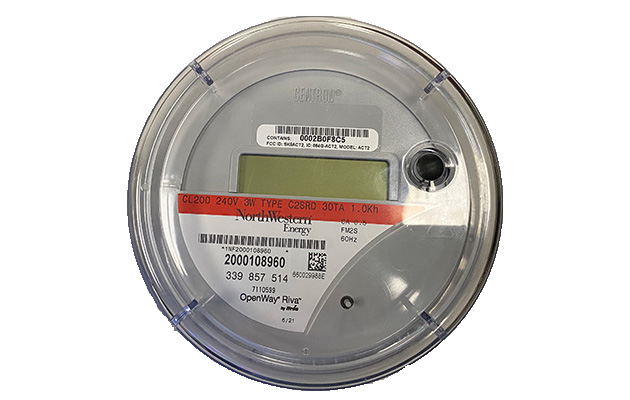
An electric AMI meter isolated on a white background

Electric meter

The basic unit of measure of electric power is the watt.  One thousand watts is called a kilowatt. 

When you use one thousand watts of power in one hour, you have used one kilowatt (kWh).

We bill you by the kWh. Your electric meter is a digital meter that has an electronic display that displays the current reading, like a digital clock.

When reading an electric meter, write down the numbers as shown on the meter.


When submitting your meter reads, please be ready with your account number, your service address, your meter read(s) and the date you read your meter(s).

Options to submit your meter reads:
NorthWestern Energy
11 E. Park St.
Butte, MT 59701

Advanced Meter FAQs

NorthWestern Energy began installation in Montana in 2021. Here is a list of approximate dates for the Montana Meter Upgrade project by area:

  • Missoula Division: completed August 2022
  • Butte Division: completed June 2022
  • Bozeman Division: completed May 2024
  • Billings Division: completed October 2024  
  • Lewistown District: completed October 2024
  • Havre District: completed November 2024
  • Helena Division: June 2024 – May 2025
  • Great Falls Division: August 2024 – 2028
No. The electric meters and gas modules are purchased and owned by NorthWestern Energy. They are part of our infrastructure, similar to our power poles and transformers.

A NorthWestern Energy employee will install your new meter or module.

Most of the installations will occur during business hours, though there will be cases when evening or weekend installations may be necessary. Customers don't need to be home.

A door hanger will let residents know their upgrade was successful. If the technician cannot perform the upgrade, a door hanger will be left with instructions to call to make an appointment.

NorthWestern Energy has a contract to recycle the electric meters and gas modules in use now when new meters and modules are installed.

Yes. The Federal Communications Commission (FCC) regulates the safety limits for all RF emissions, and smart meter and module emissions make up a small portion of the limit. The RF emissions of old one-way communication meters and the new two-way communication meters are both approved by the FCC. Radio frequency emissions are also produced by common household devices such as microwaves, baby monitors and TVs.

Yes. Customer privacy and security are NorthWestern Energy priorities. The company’s strict security standards have contributed to protecting the energy grid and customer privacy for years. The meters do not collect, store or transmit any personally identifiable information.

The meters measure total energy and cannot differentiate energy usage by appliance or anything else within a home or business. The transmitted energy use information is encrypted.

Customers who want to keep their existing meters can call NorthWestern at 888-467-2669 or email NorthWesternEnergyMeters@northwestern.com to be added to the bypass list. Customers who previously requested an opt out do not need to contact NorthWestern again to be bypassed and keep their meters.

NorthWestern will be reaching out to customers who received an advanced meter despite their request to opt out. For those who still wish to opt-out, NorthWestern will ensure that the advanced meter is removed and replaced with a meter similar to the one that was there before. Customers will not be charged for this service. 

Customers who have questions about the advanced meter opt-out program can contact NorthWestern at 888-467-2669
or the Montana Public Service Commission at 1-800-646-6150 or pschelp@mt.gov.

A Helena Homeowner’s Call Helped an Osprey—And the Right Partners Stepped In

Date: May 8, 2026

TYPE: News

Helena, Mont. – May 8, 2026 – When a Helena area homeowner noticed an osprey struggling near a nesting platform, they made a call that set a rescue in motion. With favorable weather and a service tech already in the area, NorthWestern Energy was able to provide equipment and support for wildlife professionals leading the rescue.

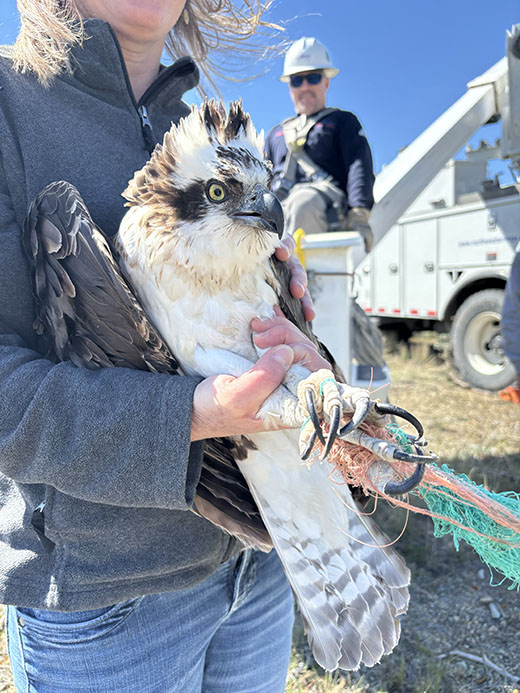
The homeowner observed the osprey with what appeared to be baling twine entangled around its legs. The Raptor View Research Institute coordinated with Northwestern Energy and Montana Fish Wildlife & Parks, whose trained professionals determined how to safely respond.
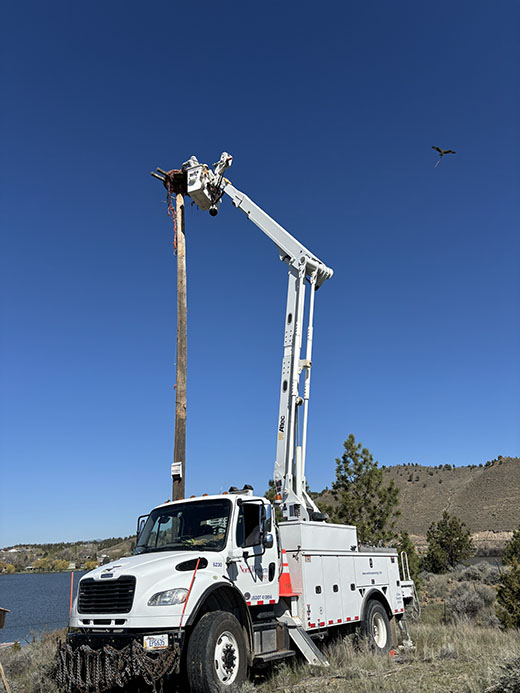
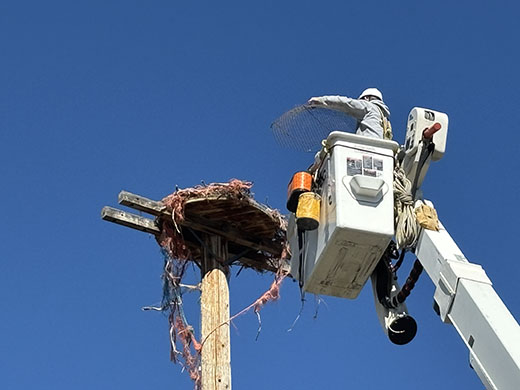
Raptor View Research Institute Executive Director and biologist Rob Domenech accessed the nesting platform on a NorthWestern Energy bucket truck. The osprey was still actively flying, but the twine posed an imminent risk of injury or death.

An osprey trap was used to briefly and safely contain the bird so it could be brought down to the ground, where Krista Smucker with Montana Fish, Wildlife & Parks held the osprey while the baling twine was carefully cut away. After the entangling material was removed, the osprey was released.

“It was fortunate that weather, service tech schedules and safety conditions aligned to support the rescue,” said NorthWestern Energy Supervisor of Electric Operations Steve Rock. “Everyone involved was pleased to see this end with a good outcome.”

Preventing wildlife entanglements begins with simple steps the public can take.
NorthWestern Energy Biologist Marco Restani’s long‑term study of ospreys along Montana’s Yellowstone River found that nearly half of nests contained plastic baling twine. https://www.sciencedirect.com/science/article/pii/S2351989423001312

“When baling twine is left unsecured, it can create serious hazards for osprey,” Restani said. “Osprey often incorporate loose twine into nests, which can be deadly for both adults and hatchlings. The best prevention is to pick it up promptly and store it in secure containers or buildings.”

NorthWestern Energy has an Avian Protection Plan that outlines operational practices intended to reduce risks to birds while maintaining reliable energy service. The plan includes measures such as installing and maintaining nesting platforms, making equipment modifications to reduce electrocutions and collisions, following established safe work practices, and coordinating with wildlife agencies and conservation organizations. Additional information about the plan is available at: https://www.northwesternenergy.com/clean-energy/our-environmental-projects/avian-conservation

Follow us on Facebook and LinkedIn and Instagram: @NorthWesternEnergy

NorthWestern Energy - Delivering a Bright Future

NorthWestern Energy, provides essential energy infrastructure and valuable services that enrich lives and empower communities while serving as long-term partners to our customers and communities. We work to deliver safe, reliable, and innovative energy solutions that create value for customers, communities, employees, and investors. We do this by providing low-cost and reliable service performed by highly-adaptable and skilled employees. We provide electricity and / or natural gas to approximately 850,300 customers in Montana, South Dakota, Nebraska, and Yellowstone National Park. Our operations in Montana and Yellowstone National Park are conducted through our subsidiary, NW Corp, and our operations in South Dakota and Nebraska are conducted through our subsidiary, NWE Public Service. We have provided service in South Dakota and Nebraska since 1923 and in Montana since 2002.


Media Contacts:

Jo Dee Black

866-622-8081

jodee.black@northwestern.com